Journey to the West Reading Guide: Which Translation to Read
Dreamsquare Team
Share this article
There is no single "best" translation of Journey to the West. There are four main options, each with honest trade-offs, and picking a mismatched one is a common reason first-timers quit. This guide offers a comparison table and a decision path the ranking pages often miss.
The real question isn't "is it good" - it's "which version, for which reader"
Journey to the West is one of the Four Great Classical Novels of Chinese literature - a 100-chapter Ming-era epic. That chapter count is exactly where most people encounter difficulty. Because the book you'll actually hold isn't the original text; it's a translation, and English versions range from a substantial abridgment covering a selection of chapters to a complete multi-volume scholarly set.
Four names consistently appear: Arthur Waley's Monkey, a beloved abridgment; Anthony C. Yu's complete edition; Julia Lovell's brisk modern Monkey King; and W.J.F. Jenner's complete text. They tell the same story in wildly different reading experiences.
The mismatched edition - not the book itself - stalls most first-timers on Journey to the West. You didn't fail the pilgrimage; you picked the four-volume complete edition when you wanted momentum, or the abridgment when you wanted the whole road.
So this guide skips crowning a single winner. Instead: a comparison table, a decision path tailored to your reading style, and an on-ramp from the Monkey King you might already know.
The translation comparison table (honest trade-offs, not a winner)
Completeness and readability pull in opposite directions. That's the core challenge. The fullest Journey to the West is also the heaviest lift, and the smoothest read leaves out a substantial portion of the novel. Every choice below is a trade-off, not a ranking.
| Edition | Completeness | Length / weight | Tone & readability | Best for | Accessibility |
|---|---|---|---|---|---|
| Waley, Monkey | Abridged (a selection of chapters, not the full 100) | Light - one slim volume | Fluid, playful, fast | Total newcomers who want momentum | Cheap, widely stocked |
| Anthony C. Yu, complete edition | Complete (commonly described as a four-volume set from the University of Chicago Press - confirm the printing you buy) | Heavy - the full pilgrimage plus scholarly apparatus | Faithful, dense, footnoted | Readers who want everything, poems and notes included | Higher cost, multi-book commitment |
| Julia Lovell, Monkey King | Abridged (Penguin Classics modern selection) | Light - one volume | Modern, snappy prose | Readers wanting contemporary voice over completeness | Affordable, in print |
| W.J.F. Jenner, complete edition | Complete text (commonly issued in multiple volumes - confirm publisher and printing for your copy) | Heavy - the full text | Straightforward, readable full-length | Readers wanting the whole novel without heavy academic framing | Availability varies by market |
A caveat you deserve: these attributes are edition specifications and editorial judgment, not measured data or a quality score. The axis that truly matters is complete versus abridged - everything else is texture. If you're unsure which side of that line you want, Dreamsquare's breakdown of when a shorter edition beats the original is a helpful detour before you buy.
How we built this comparison
This table maps opinion, not metrics - no proprietary numbers, no invented scores. We drew from community consensus on the r/Journeytothewest "best way to read" thread (a fan discussion, not an authoritative source), from study-guide overviews, the Fandom reading-guide wiki, and each publisher's edition specifications. Because volume counts and publishers get revised between printings, confirm every factual attribute - volume count, abridgment scope, publisher - against the copy in front of you.
We ranked nothing. We mapped each of the four editions to the reader it fits, because "best" depends entirely on who's holding the book. A scholar and a curious lunch-break reader need opposite things. Pretending otherwise is how ranking pages mislead you.
Which translation is right for you? A decision path
Match the edition to your appetite. Pick for momentum first, completeness later. You can always graduate from an abridgment to the full multi-volume set.
If you've never read a classical Chinese novel and you want to keep turning pages, start with Waley's Monkey - the standard on-ramp readers keep pointing newcomers toward. It's fast because it's cut down.
If that abridgment lit you up and you want the entire pilgrimage, graduate to Yu's complete edition. There, the poems, the notes, and the full episodic sprawl finally arrive. If you'd rather stay abridged but want a modern, brisk register, Lovell's Monkey King is built for that ear. And if you want the whole 100 chapters with scholarly footnotes and apparatus, Yu is the reference set; Jenner offers the full text with lighter framing.
On pace: treat it as episodic. After the setup, the novel runs like a "monster of the week" serial. A chapter or two a sitting works fine. If translation choice is what's paralyzing you, Dreamsquare's piece on translation versus modern English editions of the classics untangles the deeper question.
The on-ramp you already have: from Dragon Ball to Xuanzang's pilgrimage
You already know this story; you just met it sideways. Son Goku in Dragon Ball descends straight from Sun Wukong. Monkey Magic, the cult 1970s TV series, dramatized it. Countless video games mine the Monkey King's staff-twirling, cloud-somersaulting havoc. The frame you inherited is almost entirely Monkey.
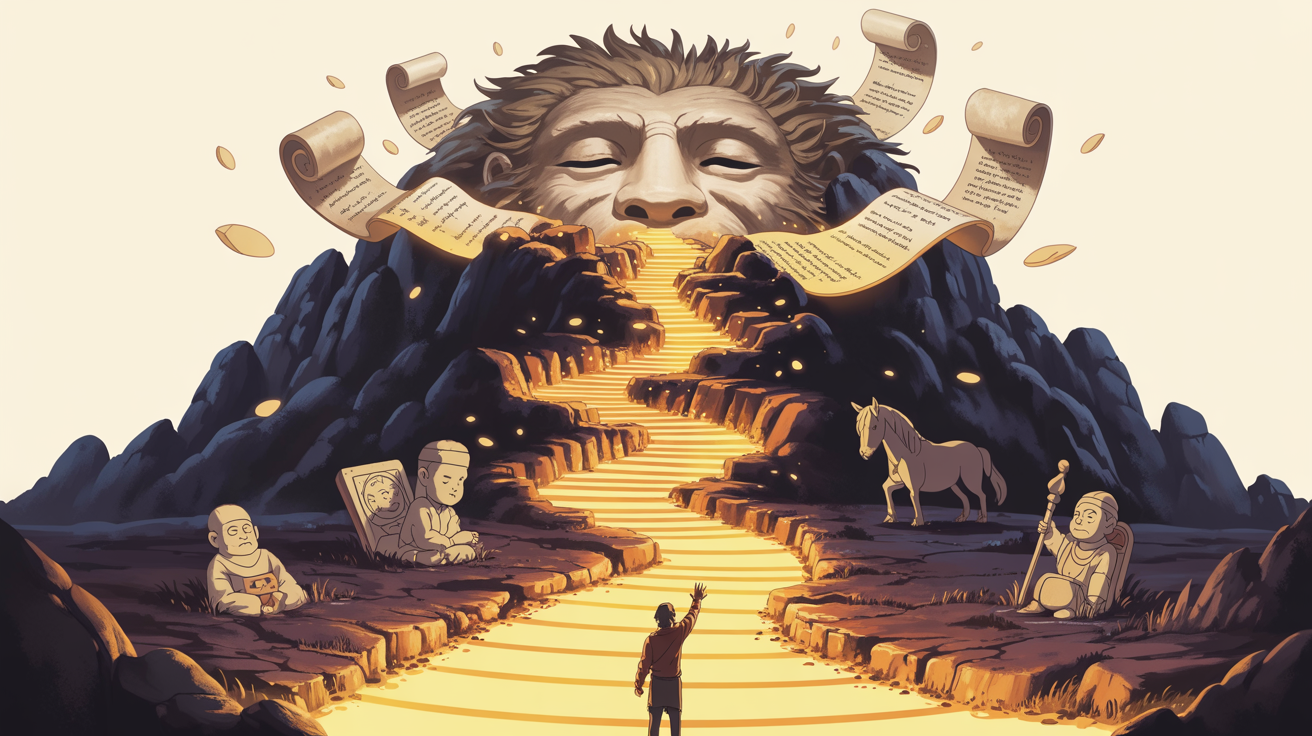
The cross-reference the adaptations never hand you: the opening chapters cover Wukong's origin and rebellion - that early slice is what pop culture keeps mining. Everything after is the road: he stays the protagonist, but the story becomes a full ensemble and shifts from cosmic rebellion to episodic, monster-of-the-week trials. His rampage through Heaven is the opening act. Then he's pinned under a mountain and drafted as a bodyguard - a kind of cosmic community-service sentence, and the exact point where every screen version tends to fade out.
The real story is a full cast on a pilgrimage: Tang Sanzang's journey west, Zhu Bajie's appetite, Sha Wujing's endurance, and Guanyin's guidance. So when a game hands you only the staff-twirling monkey, you're holding the flashy origin, not the discipline of the road that fills the rest of the hundred chapters.
That gap between "Sun Wukong's origin" and "the pilgrimage story" is exactly why the book-to-adaptation pipeline keeps returning to this well. If you'd rather hear the episodic epic than read it, an audiobook is one legitimate way in. And yes, audiobooks count as reading.
Four myths that make it feel unreadable
Most of what scares you off is folklore about the book, not the book itself.
Myth 1: one tidy author wrote it
Authorship is traditionally attributed to Wu Cheng'en. But it's genuinely disputed, and the tale grew out of oral tradition. As encyclopedia summaries note, some scholars question whether early references to a "Journey to the West" point to this novel at all - the reference could be any version of the story. Treat the single-author story as convenient shorthand, not settled fact.
Myth 2: you must grasp every allusion
Chapter one is dense with cosmology - Pangu's creation, the four continents. It's a wall people bounce off. But the reading-guide wiki says plainly that first-read comprehension of that chapter-one machinery isn't essential. Keep moving.
Myth 3: you must read all 100 chapters strictly in order
After the setup, the structure is episodic. That "monster of the week" rhythm again. Jumping to a famous ordeal is legitimate, not cheating.
Myth 4: the adaptations are faithful
They're a slice, and often a loose one. If the distinction matters to you, Dreamsquare's explainer on what separates a modernized classic from a retelling draws the line.
You do not have to decode Pangu and the four continents to enjoy chapter one - the book's own guides tell you to keep moving. A quick anchor: Xuanzang was a real 7th-century monk who traveled to India for Buddhist texts; the novel fictionalizes that trip across the Ming dynasty (1368-1644), framing its pilgrims' ordeals as 81 tribulations - a traditional count tied to the text's own numerology rather than a literal tally of 81 discrete adventures.
Who it's for
There's a right on-ramp for the total newcomer, the returning reader, and the Chinese learner. The mistake is assuming one edition serves all three.
First-timers: start with an abridgment, read episodically, and don't chase footnotes. Momentum is the point. You can always deepen later. Returning readers who already loved the story: graduate to Yu's complete edition for the full pilgrimage and its apparatus - the version that gives you the poems and the parts the adaptations skipped.
Language learners have a route of their own. Imagin8 Press describes its Journey to the West series as a graded reader in "Simplified Chinese, pinyin and English," spread across a multi-volume set aimed at people learning to read Simplified Chinese. That's the publisher's own description, offered as an option, not an endorsement. And for anyone who simply prefers listening, an audiobook works.
Your next move
The best version of Journey to the West is the one you'll actually finish a chapter of tonight.
Pick the edition that matches your appetite and start this week. Momentum beats completeness every time. You fall for the story first, and only then does completeness start to matter.
Concretely: read one episodic chunk. Skip whatever cosmology doesn't land. Decide later whether to graduate to the full multi-volume set - like a director's cut you circle back to once the theatrical version hooks you. As a centuries-old public-domain classic (Ming-era, 16th century), it's the kind of out-of-copyright text Dreamsquare's modernized editions and audiobooks are built for. For readers who want a modernized or audio on-ramp, Dreamsquare's book catalog is one of several options, not the only door in.
FAQ
Based on edition specifications and community consensus, not a ranking or quality score:
Which translation of Journey to the West should I read - Waley, Yu, Lovell, or Jenner?
It depends on your reading goals. Waley's Monkey is the fast abridged on-ramp readers keep recommending to newcomers. Yu's complete edition is the footnoted option; Lovell's Monkey King is a modern abridgment; Jenner offers the full text with lighter framing. Prioritize momentum first, completeness later.
Should I start with an abridged version or the full multi-volume translation?
If you've never read a classical Chinese novel, start abridged. The complete text, roughly 100 chapters, rewards readers who already love the story. You can always graduate from the abridgment to the full edition once you're engaged.
Do I have to read all 100 chapters in order, or can I jump around?
After the opening setup, the novel functions like a "monster of the week" serial. That episodic structure means jumping to specific episodes is legitimate. Read the origin arc first, then feel free to explore other sections.
How does the original novel compare to the Monkey King adaptations I already know?
The pop-culture Monkey King - from Dragon Ball, Monkey Magic, and numerous games - largely draws on his origin and rebellion in the novel's opening chapters. Wukong stays the protagonist through most of the pilgrimage, but the novel becomes a full-cast journey involving Tang Sanzang, Zhu Bajie, Sha Wujing, and Guanyin. Adaptations typically show a slice, not the entire journey.
Stay in the loop
Get notified when we publish new stories about books, storytelling, and the magic of reading.
Stay in the loop
Get notified when we publish new stories about books, storytelling, and the magic of reading.