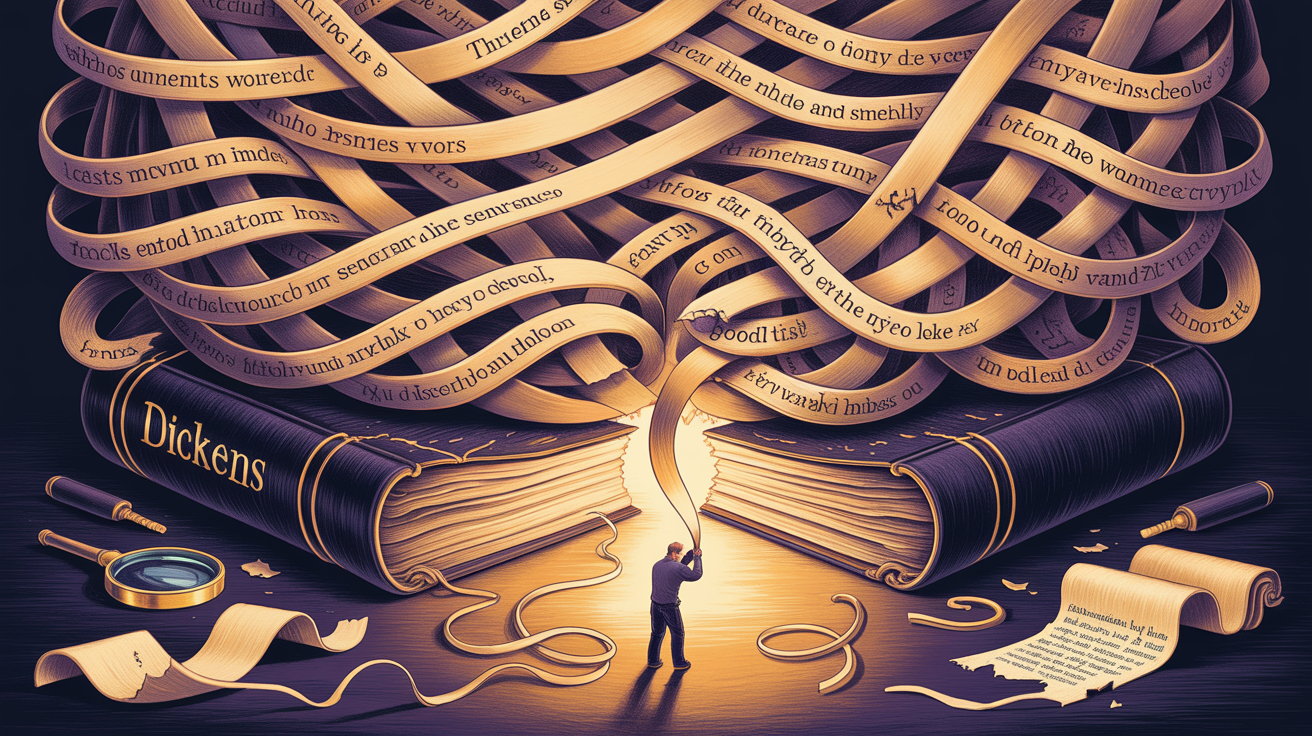
Decoding Dickens: Why His Sentences Feel So Difficult
Dreamsquare Team
Share this article
Dickens is challenging because of his sentence structure, not complex vocabulary. He frequently places subordinate clauses before the main verb, delaying the core meaning. Learning to identify the verb first clarifies these passages.
The real barrier is sentence architecture, not vocabulary
If you've struggled with Bleak House, it wasn't because you didn't know what "Chancery" meant. The sentence structure often requires you to hold several half-finished thoughts before revealing the central action. This isn't a vocabulary issue; it's a matter of architectural design.
Here's the point that gets missed: "long sentences" describe a symptom, not the underlying problem. One recognizable pattern in Dickens is the delayed main verb. He loads the beginning of a sentence with subordinate clauses, appositives, and asides. Your brain must keep these elements unresolved until the grammatical spine finally connects.
Dickens defers the verb, forcing your brain to hold a stack of half-finished thoughts until the meaning finally lands.
Readers conflate four distinct difficulties. There's syntax-the clause-stacking described above. There's dead diction-words like "gladsome" that are no longer common. There's lost idiom and irony-Victorian jokes and social cues that require historical context. And there's sheer length and pacing-the volume of an 800-page novel. Each requires a different approach. Suggesting "just persist" for all four is part of why many readers give up.
Fluent native speakers hit these walls too. This isn't a failure of fluency or mindset. One reader on r/books described the experience as reading where the meaning only resolves "retrospectively," requiring them to "keep plowing ahead" until a paragraph makes sense-calling it "an act of faith." That's a precise description of what his syntax does to you. It's not an indication that you are reading incorrectly.
Teardown: three real Dickens sentences and why each one stalls you
Let's examine the mechanics rather than just describing them. Try circling the main verb in a clause-heavy Dickens sentence. You'll often find three or four clauses preceding it, like a queue. That queue is the difficulty. Not every hard Dickens passage works this way, though-as the first two examples below show, he has more than one tool for slowing you down.
1. The opening of Bleak House
"Fog everywhere. Fog up the river, where it flows among green aits and meadows; fog down the river, where it rolls defiled among the tiers of shipping and the waterside pollutions of a great (and dirty) city."
Notice the structure-and notice that this passage works by the opposite mechanism from the delayed verb. "Fog everywhere" isn't a complete sentence; it has no verb at all, and Dickens never supplies one. He piles up fragment after fragment-fog "up the river," fog "down the river"-in an extended verbless catalogue. This is a different category of difficulty: not a verb buried under clauses, but a verb deliberately omitted, so that atmosphere accumulates before any character acts. You're not reading a direct statement; you're experiencing impressionistic layering. Comprehension is deferred because Dickens wants the fog to establish itself before the plot unfolds.
2. The opening of A Tale of Two Cities
"It was the best of times, it was the worst of times, it was the age of wisdom, it was the age of foolishness, it was the epoch of belief, it was the epoch of incredulity..."
This too differs from the delayed verb-here the verb is right in front of you, repeated over and over. Every clause contains "it was," yet nothing concrete is asserted. That's the trap, and it's rhetorical rather than syntactic: a long anaphoric chain of parallel "it was" clauses, none advancing the narrative, all demanding the same rhythmic beat. The challenge isn't the individual words, and it isn't a missing verb; it's the cadence. You anticipate the sentence to resolve, and it refuses to for the length of the paragraph. The "find the verb" trick won't help you here-the verb is present ten times over-but naming why the sentence withholds progress does.
3. The buried main verb
Now the pattern the "find the verb" trick actually targets. Since this is a pattern rather than a single passage, treat the following as an illustration of the delayed-verb structure rather than a verbatim quote: Dickens will open a sentence with "Although," qualify it with a "which" clause, insert a dash and a second aside, name a character, describe the surrounding weather-and only then, three or four clauses deep, arrive at what the subject actually did. To see it in a real Dickens sentence, take any clause-heavy passage from Bleak House, identify the main verb, and count the clauses stacked ahead of it. That queue is precisely why your eyes glaze over.
The two openings above, like all of Dickens's novels, are in the public domain and verifiable verbatim via Project Gutenberg. The quotes are freely available; the analysis is the key. Find the verb, and the preceding setup transforms from a blur into its intended role: preparation.
Why the sentences are built this way: journalism and the serial deadline
Dickens's expansive prose was less about padding for pay and more about writing for monthly cliffhangers. The serial calendar shaped his style, not a per-word payment scheme.
Consider his origins. Dickens began as a parliamentary reporter, and a 2020 post on the University of Birmingham's CLiC Dickens project blog observes that his early journalism used comparatively less figurative language than his novels. His later, richly descriptive style reads less like a lapse in discipline than a deliberate shift toward the kind of expansive prose his fiction demanded. The long sentences are a chosen stylistic instrument rather than carelessness.
Then there's the mechanism: serialization. Dickens published most of his novels in monthly installments, meaning each segment needed to end with a hook. It had to maintain suspense over a four-week interval and fill a specific page count. This structure rewarded digression-the descriptive passages, the array of minor characters, the tangents that encouraged continued subscriptions. The pacing you perceive as "slow" reflects the pacing of a magazine serial, not a modern novel.
That serial economics point also corrects the most durable myth about Dickens: "He was paid by the word." He wasn't-he was typically paid per installment, so the incentive was to keep readers buying the next issue, not to inflate sentence count. Installment economics did drive length and tangents, but the per-word payment mechanism doesn't hold up. The Charles Dickens Museum notes these tangents in its guide for struggling readers without tying them explicitly to the serial form-a connection worth drawing, since the publication calendar shaped the prose.
A counterargument, examined: "it's just a mindset"
A Quora answer dismisses the entire problem, calling reading Dickens a "mindset," and claiming he's no harder than Tolstoy or Thackeray. Attitude certainly plays a role-a defeated reader quits faster-but the difficulty isn't purely a mindset issue, and here's the problem with that view.
The clause-stacking architecture is tangibly present on the page. It's in the text itself, not solely in your perception. A fluent reader can approach Bleak House with an excellent mindset and still struggle with the syntax, because in the clause-heavy passages the syntax is genuinely front-loaded. You cannot will your way past a verb that has not yet appeared.
Consider it like turn-by-turn directions. A Dickens sentence is like a navigation voice saying: "at the roundabout, past the old church, in the rain, once you've gone by the inn-turn left." The instruction isn't absent; it's buried under four qualifiers, and you've already drifted into the wrong lane by the time it arrives.
Telling a struggling reader it's "just a mindset" is like blaming the driver for missing a turn announced four clauses too late.
Still, the difficulty often lessens with exposure. Another commenter on the same r/books thread reports becoming "more accustomed to those long sentences" the more they read. This is reported experience, not a universal guarantee. But it points to a plausible truth: the obstacle is skill-based and structural, meaning it can be trained. A purely mindset-based problem would be less likely to yield to practice this way.
The fix-the-sentence toolkit
Different difficulties require different solutions. Read aloud for syntax, annotate for dead idiom, and select your edition based on length. Persistence alone only addresses one of these. Matching the tool to the problem prevents wasted effort.
For syntax, read aloud. The prose was designed for cadence, and readers consistently find that sentences that feel tangled on the page untangle when spoken-the rhythm guides you to the verb. And use the most transferable trick from the teardown: find the main verb first, then reread the preceding clauses as the setup they are.
For dead diction and lost idiom, consult an annotated edition. When Dickens writes "gladsome looks," or makes a joke reliant on 1850s London knowledge you lack, no amount of reading aloud will clarify it. You need a footnote, not more willpower. Stack Exchange readers describe his habit of finding "artful synonyms for basic, relatable concepts," which annotations effectively address.
For length and the textual barrier itself, consider your format. A modernized edition updates the syntax and archaic vocabulary into contemporary phrasing-Dreamsquare's catalog of modernized classics offers this as one option, alongside the unabridged original. If you prefer to bypass the page entirely, Dreamsquare's Theatre Mode audiobooks use multiple voice performers to handle the reading-aloud for you. To weigh the tradeoffs, our breakdown of modernized versus original English and the Theatre Mode audio experience both explain when each option makes sense. These are options, not replacements for the original, which retains all its value.
Which Dickens to start with-an accessibility ranking with reasons
A Tale of Two Cities is not the best first Dickens for most readers. This isn't because it's a lesser work, but because it prominently features the exact accumulation that discourages newcomers.
Reddit's common advice is "try a different book," often without explanation. Here are the reasons. A Tale of Two Cities opens with an anaphoric pile-up and relies on a dense French Revolution historical context you're expected to recall-combining high rhetorical load with high contextual demands. It's a deep dive.
Start with something more accessible. A Christmas Carol is short, tightly plotted, and famous enough that the story carries you through the syntax-you already know the narrative arc, so the sentences require less effort. Like a classic film referenced so often you know the ending before you've seen it, A Christmas Carol's story is so culturally pervasive that many readers already know the plot before opening the book. Great Expectations is a good next step: character-driven, first-person, propulsive, with less intense clause-stacking than his larger social panoramas. Save Bleak House and A Tale of Two Cities until you've built your reading endurance.
But honesty dictates: even the "easy" Dickens is still Dickens. A Christmas Carol still contains descriptive passages that defer the verb. A gentler entry point lowers the barrier; it doesn't eliminate it. That's the appropriate expectation to set.
Practical takeaway: what to do with your next Dickens page
The next time a Dickens sentence slows you down, don't just push harder.
Find the verb, and read the preceding clauses as the setup they were always intended to be. Then match your remaining friction to the correct solution instead of defaulting to sheer willpower. A syntax knot? Read the sentence aloud. A word or joke you don't understand? That's diction or idiom-consult an annotation, not more effort. Overwhelmed by sheer volume? That's a format decision, and our volume-reading guide covers how to build stamina for it.
The reported experience is valid. Many readers report that the syntax becomes more legible with practice, and if that holds for you, the reward is Dickens at his full voice-worth the training. If you've struggled before and are considering restarting, our diagnostic for restarting classics is designed for precisely that decision. Find the verb. Read the queue as setup. Turn the page.
FAQ
Why is Dickens so hard to read even though I'm a fluent English speaker?
The difficulty is structural, not a matter of fluency. In many passages Dickens front-loads sentences with subordinate clauses, delaying the main verb, so you hold several unresolved thoughts before the core meaning is revealed. Elsewhere he uses verbless fragments or long anaphoric chains for atmosphere and rhythm. Native speakers also encounter these challenges; it's the sentence architecture, not your vocabulary or reading skill, that creates the difficulty.
Which Dickens novel is the easiest to start with?
Begin with A Christmas Carol-it's short, its plot is widely known, and the familiar story helps carry you through the syntax. Next, try Great Expectations, which is first-person and character-driven with less dense clause-stacking. Save A Tale of Two Cities and Bleak House for later, as both present significant stylistic and contextual demands simultaneously.
Should I read a modernized or abridged version of Dickens instead of the original?
This depends on the specific challenge you're trying to overcome. A modernized edition updates the syntax and archaic vocabulary, which is a direct solution if the sentence structure is your primary barrier. An abridgment shortens the length but cuts content. Our comparison of abridged versus original versus modernized explains when each option is appropriate. None of these alternatives diminishes the value of the original text; they simply offer different pathways to engagement.
Why did Dickens write such long books-was he paid by the word?
The idea that Dickens was paid by the word is a myth; he was typically paid by the monthly installment, meaning his incentive was to keep readers subscribing between issues. This serial structure-which encouraged cliffhangers, fixed page counts, and opportunities for digression-is what primarily drove the length and tangents in his novels, not a per-word payment scheme.
Stay in the loop
Get notified when we publish new stories about books, storytelling, and the magic of reading.
Stay in the loop
Get notified when we publish new stories about books, storytelling, and the magic of reading.