From Book to Vertical Series: The New Adaptation Pipeline
Dreamsquare Team
Share this article
There’s a pipeline that nobody has fully named yet, but several of the most valuable companies in entertainment are quietly building it.
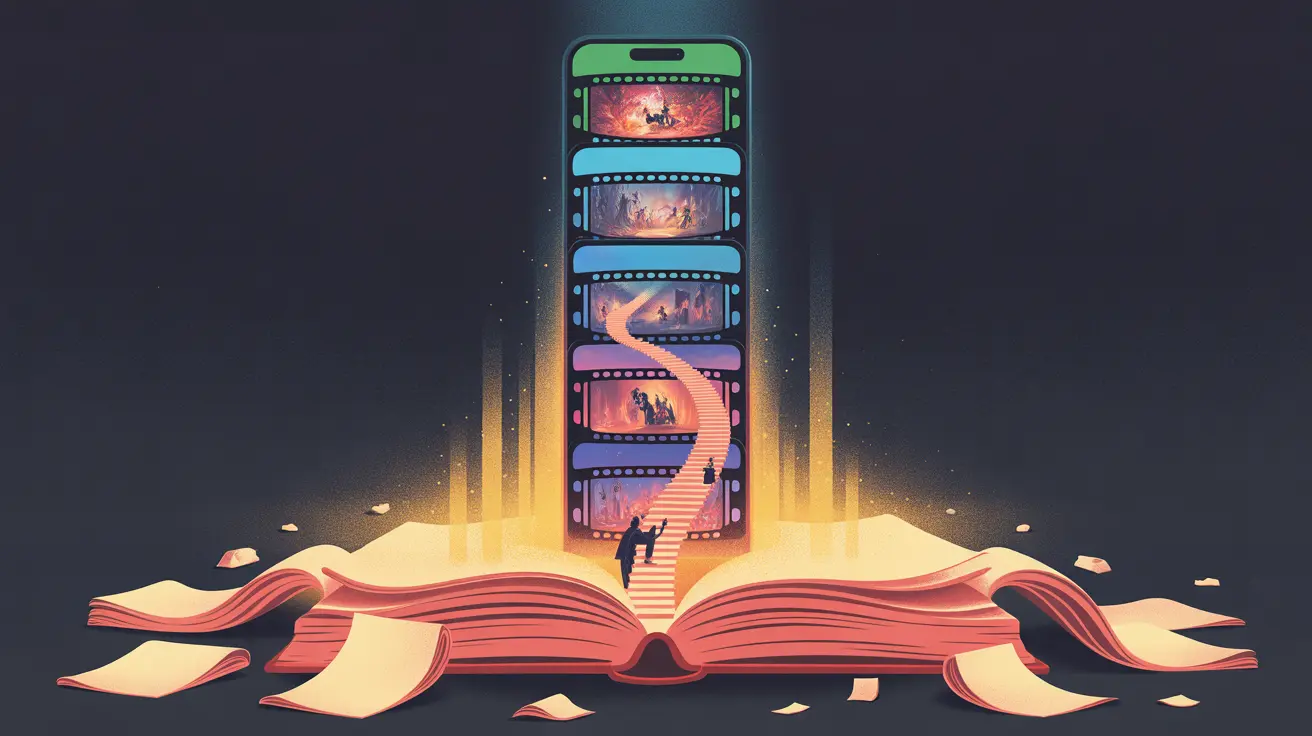
It starts with a book — or, more precisely, with IP. A story that has proven itself with readers, that carries established emotional hooks, that an audience already exists for. And it ends with a vertical series: 60 to 120 episodes of 90-second mobile-first drama, unlocking one cliffhanger at a time.
Between those two endpoints is where the interesting decisions get made. And increasingly, the companies that understand both ends of the pipeline — the literature and the format — are the ones finding the clearest path.
Why Books Are the Ideal Source for Vertical Drama
The microdrama format has a content problem that’s hidden under its growth numbers. Global revenues hit $11 billion in 2025 (Omdia). US revenues alone reached $819 million in 2024. The format is scaling. But most vertical series are built on a narrow band of original concepts: billionaire CEOs, forbidden romance, werewolves, revenge arcs. The same structures repeat across platforms, the same tropes appear in different costumes, and brand loyalty is low because the content is largely interchangeable.
This is a sourcing problem, not an audience problem. The audiences are there and paying. What’s missing is IP with real depth — stories that come pre-loaded with emotional complexity, established characters, and narrative arcs that extend naturally across 80 episodes without running dry.
Books solve this directly.
A novel like Rebecca already has a compulsive, cliffhanger-driven structure — du Maurier wrote it as a psychological thriller with sustained dread across every chapter. The Great Gatsby has the social jealousy and class drama that vertical series run on. Wuthering Heights has the obsessive, transgressive romantic conflict that drives the highest-performing microdrama categories. These stories have been proven over decades across languages and cultures. Their emotional logic is not experimental.
The question is whether they can be adapted — and the answer, for the right source material handled correctly, is yes.
What the Adaptation Actually Requires
Book-to-vertical adaptation is not the same as book-to-film or book-to-TV series. The format has specific requirements that most adaptation thinking hasn’t yet internalized.
Episode structure. Each 90-second episode needs a micro-arc: an entry point, rising tension, and a cliffhanger exit. That’s not a scene. It’s a structural unit. A 200-page novel might yield 80 to 100 of these units if the pacing is right. For plot-dense books with natural chapter-level tension, this is tractable. For meditative literary novels built on interiority and prose rhythm, it’s much harder.
Vertical framing. The 9:16 aspect ratio constrains what you can show and forces different production choices. Two-person dialogue scenes work naturally. Landscape panoramas and ensemble crowd scenes don’t. The format favors close emotional performance over visual spectacle — which, interestingly, aligns well with literary adaptation. Books are primarily about inner life and interpersonal conflict; so is vertical drama.
Tone calibration. The dominant vertical drama genres — romance, revenge, supernatural — skew melodramatic by design. This isn’t a flaw in the format; it’s format-appropriate. The emotional intensity that makes a reader turn pages at midnight maps directly to the engagement mechanics that make a viewer unlock the next episode at 1 AM. Classic literature with strong melodramatic elements (Hardy, Brontë, Dickens) translates more naturally than restrained, ironic, or ambiguous fiction.
Pace compression. A 350-page novel into 80 episodes of 90 seconds is roughly 6,000 words of narrative. That’s under 2% of a typical classic’s length. This isn’t abridgment — it’s structural translation, closer to what happens when a stage play becomes a screenplay. The emotional spine must survive intact. The subplots, the texture, the secondary characters: these require active choices, not passive cutting.
Where the Two Formats Actually Converge
Dreamsquare operates at exactly this intersection — which is, in retrospect, an obvious place to be.
The book platform exists to make classic literature more accessible: modernized editions that preserve the story and voice while removing the language friction of 19th-century prose, and micro editions that compress the narrative to its essential arc. These are, structurally, the same creative operations that book-to-vertical adaptation requires. You’re identifying the emotional spine of a story, deciding what must survive any compression or translation, and rendering it in a form the contemporary reader — or viewer — can enter without a barrier.
The VOD platform exists to build vertical drama for European audiences with European stories, in the format that has already proven itself in China, the US, and Southeast Asia. The European market is still early in the vertical drama curve. Non-China revenue hit $3 billion in 2025 and is projected to reach $9.5 billion by 2030, with the US leading but Europe beginning its own acceleration. The gap in the market isn’t production capability or audience appetite. It’s local IP — vertical series that feel European in setting, character, and emotional register rather than transplanted American or Chinese concepts.
Classic European literature is one of the most substantial IP libraries in existence, and most of it is in the public domain. The emotional material in Balzac, Dumas, Hardy, Turgenev, Flaubert, and dozens of others is exactly the material vertical drama runs on: class conflict, forbidden love, social ambition, revenge, betrayal, and the specific kind of melodramatic intensity that European literature developed to a high art. None of these authors have been meaningfully exploited in the vertical format. That’s not a gap that will stay open.
The Platform Race and Where It Leads
The current microdrama landscape is dominated by platforms built around Chinese IP pipelines — COL Group behind ReelShort, Dianzhong Technology behind DramaBox — and a small number of newer entrants building local production capability (Vigloo for Korean and US markets, Holywater with Fox Entertainment backing for Western content).
What all of these platforms share is a sourcing model built around original scripts and online literature IP. The connection to canonical published literature is largely untapped. This creates a specific opportunity window: before the major platforms invest in classic IP adaptation at scale, the market for locally-produced vertical drama built on established European literary IP is open.
The mechanics work. The audience is there — the same demographic (women 25–45) that drives vertical drama is also the demographic that has led the physical book revival, with Gen Z close behind. The format is proven. The IP is available.
What’s been missing is the platform that treats literary adaptation as a serious vertical drama strategy rather than a novelty.
From Page to Screen to Pocket
The adaptation pipeline from book to vertical series is not a straight line. It passes through creative decisions that most platforms aren’t set up to make well — decisions about what survives adaptation, what the emotional core of the story actually is, how to render interiority as performance rather than narration.
These decisions are exactly what the work of building a modernized or micro edition of a classic text requires. The operational knowledge is transferable. The creative infrastructure overlaps substantially.
Dreamsquare’s book platform and VOD platform exist on either side of the same bridge — one end is the reader, one end is the viewer, and in the middle is a story that has survived long enough to matter to both.
That story, translated faithfully into a new format, is what the next phase of vertical drama is going to be built on. The first platforms to build that pipeline own the category. The format is ready. The IP is available. The audience is already watching.
FAQ
Can classic books be adapted into vertical drama series? Yes, with the right source material. Classic novels with strong melodramatic tension, clear moral conflict, and episodic structure adapt well to the vertical format. Works like Rebecca, Wuthering Heights, The Count of Monte Cristo, and Great Expectations have the emotional DNA that vertical drama runs on — sustained cliffhangers, forbidden desire, class conflict, revenge arcs. The adaptation challenge is structural translation rather than creative compromise.
What makes vertical drama different from traditional TV adaptation? Vertical drama consists of 60–120 episodes of 90 seconds each, shot in 9:16 portrait orientation for mobile viewing. Each episode functions as a micro-arc with its own cliffhanger. The format is built for phone screens, commute viewing, and habitual daily consumption — closer in structure to serialized 19th-century fiction than to prestige TV. The emotional register is melodramatic by design; it rewards strong, clear stakes over ambiguity.
What is the European opportunity in vertical drama? The non-China microdrama market reached approximately $3 billion in 2025 and is projected to reach $9.5 billion by 2030 (Owl & Co, Omdia). Europe is early in this cycle — most vertical drama available to European audiences is American or Chinese IP. Local production using European literary IP, European settings, and European characters represents an open category in a format that has already proven commercial viability at scale. Dreamsquare’s VOD platform is building for this gap.
What is Dreamsquare’s approach to the book-to-vertical pipeline? Dreamsquare operates both a book platform — modernized and micro editions of classic literature — and a VOD platform for European microdrama and vertical short film. The creative competency developed in literary adaptation (identifying the emotional spine of a story, compressing it faithfully, rendering it for contemporary audiences) transfers directly to vertical drama production. Both platforms are built on the same premise: great stories deserve formats that modern audiences can actually enter.
Stay in the loop
Get notified when we publish new stories about books, storytelling, and the magic of reading.
Stay in the loop
Get notified when we publish new stories about books, storytelling, and the magic of reading.