The Great Gatsby: The Problem Was Never the Story
Dreamsquare Team
Share this article
The most-assigned novel in American high schools is also one of the most abandoned. Teachers know it. Students know it. Every year, The Great Gatsby goes back on the syllabus — and every year, a chunk of readers bounces off Chapter 1 and never actually meets Jay Gatsby.
That’s not a story problem. It’s an entry point problem. And a hundred years after publication, there are finally better options for how you read it.
The Story Has Lasted a Century. That Tells You Something.
F. Scott Fitzgerald published The Great Gatsby on April 10, 1925. It sold fewer than 40,000 copies before he died fifteen years later — one of the most dramatic delayed arrivals in literary history. By the 1950s it was in classrooms everywhere. A hundred years on, it’s running on Broadway. Two separate musical adaptations within a single year. Generating films, memes, academic papers, and TikTok analyses in equal measure. The Modern Library ranked it the second-best English-language novel of the 20th century.
The book works. So why do so many people never finish it?
Part of the answer is that Gatsby operates as a projection screen. CU Boulder professor Martin Bickman notes that Jay Gatsby is intentionally vague — just mysterious enough for readers to cast their own assumptions onto him. One generation reads him as the American dreamer. Another sees the original influencer, manufacturing identity for an audience. Another finds a cautionary tale about class-climbing dressed up as romance. The character bends to fit whoever is reading him.
Most hundred-year-old characters feel like artifacts. Gatsby feels like someone you might have met last year.
The Prose Problem Is Real
Chapter 1 of The Great Gatsby is genuinely hard to enter. Let’s not pretend otherwise.
Not because of vocabulary — Fitzgerald wasn’t writing in archaic English. But the rhythm is something else entirely. Nick Carraway’s narration layers itself, circles back on memory without signaling the shift, moves through time sideways. Long, ornate sentences that mirror the excess of the Jazz Age. Deliberately. One teacher who has spent years on this novel calls Chapter 1 “a wall” — the thing students need scaffolding through before they can engage with anything else.
Okay, that’s a bit oversimplified. What actually trips readers isn’t difficult words. It’s unfamiliar cadence. A 1920s literary rhythm that contemporary readers simply aren’t trained for. The Lexile score sits at 1070, which sounds manageable. It doesn’t capture the real friction.
One teacher put it plainly: the language will “tempt struggling readers to close the book and never open it again.”
And here’s the honest nuance: Fitzgerald’s ornate style is intentional. The excess of language mirrors the excess of Gatsby’s world. You can’t strip it from the original without losing something real. But — and this matters — that doesn’t mean every reader needs to fight through 1920s sentence construction to reach a story about ambition, class, and the impossibility of escaping who you were born as. Those themes are universal. The delivery doesn’t have to be fixed in 1925.
Nobody finishes a book they abandon in Chapter 1. Nobody.
What 2021 Changed
In 2021, The Great Gatsby entered the public domain. Usually treated as a legal footnote. It isn’t.
Public domain means the story belongs to everyone. Adapters, publishers, modernizers — all free to work with it now. The argument that film critic Roger Ebert made in 2011, furiously objecting to a simplified ESL edition of Gatsby, looks different today. Ebert was right that Fitzgerald’s prose IS the novel, not merely a vehicle for it. But his objection rested on a false binary: either the original 1920s prose, or a gutted version that loses the soul.
That’s not the only choice anymore.
A modernized classic isn’t a summary. It isn’t SparkNotes. The characters stay. The symbolism stays. The green light across the bay stays. What changes is the prose rhythm — updated so contemporary readers can actually enter without scaffolding. Fitzgerald’s tone, not Fitzgerald’s 1925 sentence construction. For anyone looking to read classic books in modern English, this is exactly the kind of edition that makes the difference between finishing Gatsby and abandoning it before Daisy even appears.
What Gatsby Sounds Like When the Barrier Is Gone
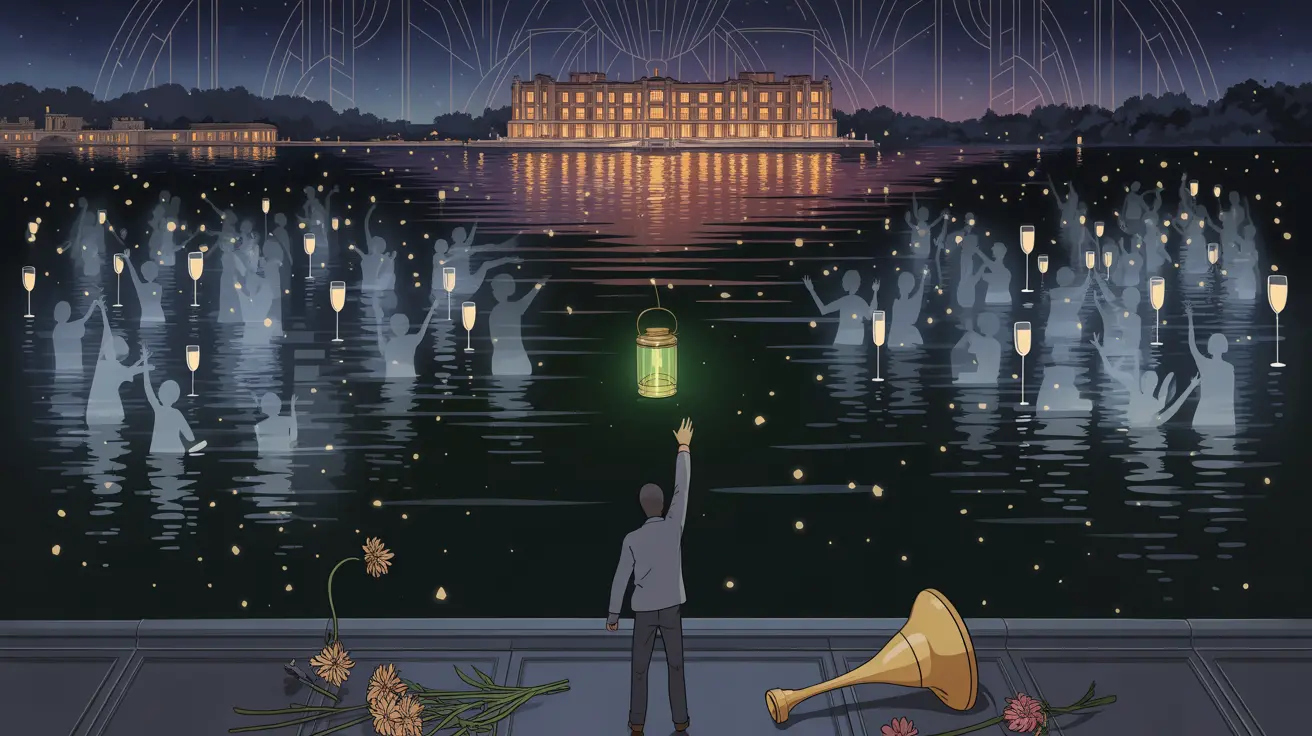
Jay Gatsby is the original reinvention story. Poor boy from nowhere. Falls for a girl whose voice — in Fitzgerald’s description — is “full of money.” Goes to war, builds a fortune through legally dubious means, buys a mansion across the bay from Daisy’s house, and throws legendary parties hoping she’ll wander in.
The ambition is borderline delusional. The longing is completely human.
Tom Buchanan — violent, arrogant, old money — is everything Gatsby can never be regardless of earnings. Daisy is caught between them in a way that indicts the whole social system. Nick watches, tries to stay neutral, fails. The Valley of Ashes sits between the glittering parties and New York City, a reminder of who pays for all that light.
None of it requires archaic language to land. The green light — Gatsby’s green light at the end of Daisy’s dock — is one of the most powerful images in 20th-century literature because it’s simple. Visible. Just out of reach.
When you can read the novel without friction every other paragraph, the symbolism doesn’t need explaining. It just hits.
Dreamsquare’s modernized edition of The Great Gatsby keeps the full story and its emotional architecture while updating the prose for readers who weren’t trained on Jazz Age English. For those who want to experience this classic in a single sitting: the micro edition runs at roughly a quarter of the original length without cutting the story arc. Just the signal. And the Theatre Mode audiobook puts you inside Gatsby’s parties rather than asking you to reconstruct them — multi-voice, immersive sound design, the Jazz Age rendered rather than described.
The Green Light Was Always There
Fitzgerald’s last line — boats against the current, borne back ceaselessly into the past — is about the gap between where you started and where you want to be. The way the past shapes what you reach for, even when the reaching is futile.
Most people encounter it as a vague sentiment. Read in full context, after Gatsby’s whole arc, it lands like a quiet conclusion. Precise and final.
The Great Gatsby doesn’t have a relevance problem. It has an entry point problem. For the first time in a century, that entry point has changed.
FAQ
Is The Great Gatsby difficult to read? The vocabulary isn’t the issue — Fitzgerald wrote in modern English, not archaic prose. The challenge is rhythm: Jazz Age cadence, layered time shifts, an ornate narrative style that takes adjustment. A modernized edition of The Great Gatsby handles this without losing the story or its emotional weight. Most readers find they finish it easily once the prose friction is gone.
How long does it take to read The Great Gatsby? The original runs around 47,000 words — roughly 3 hours at an average reading pace. In micro edition form, the same story takes about 45–60 minutes. The Theatre Mode audiobook runs longer, but the experience is qualitatively different from both.
Why is The Great Gatsby still worth reading in 2025? Because the themes don’t age. Class mobility, identity performance, the gap between aspiration and reality — permanent human concerns. The right edition makes the story available. What you do with it after that is yours.
Stay in the loop
Get notified when we publish new stories about books, storytelling, and the magic of reading.
Stay in the loop
Get notified when we publish new stories about books, storytelling, and the magic of reading.